Quick Answer
A digital marketing agency helps small businesses get found online, attract the right customers, and turn them into paying clients. It handles services like SEO, local SEO, Google Ads, social media, content, email marketing, website design, and reporting, so business owners can focus on running their business while experts grow it.
Key Takeaways
- An agency plans, runs, and measures your online marketing for you.
- Most small businesses pay between $1,000 and $5,000 per month for agency services.
- Paid ads bring results in days. SEO takes 4 to 12 months.
- In 2026, good agencies also optimize for AI search tools like ChatGPT and Google AI Overviews.
- The right agency reports on leads and sales, not just likes and clicks.
What Is a Digital Marketing Agency?
A digital marketing agency is a team of specialists who promote businesses online. Instead of hiring a separate SEO expert, ad manager, designer, and writer, you get all of them under one roof.
For a small business, an agency works like an outsourced marketing department. You share your goals. They build the plan, do the work, and show you the results.
What Does a Digital Marketing Agency Do for Small Businesses?
Here’s the simple version. An agency does five big jobs:
- Gets you found on Google, Maps, social media, and AI search tools.
- Brings you traffic through ads and content.
- Turns visitors into leads with a website that converts.
- Keeps customers coming back through email, SMS, and reviews.
- Tracks every dollar so you know what’s working.
Now let’s look at each service in detail.
12 Core Services a Digital Marketing Agency Provides
1. Marketing Strategy and Research

Every good campaign starts with a plan. The agency studies your target audience, your competitors, and your market. Then it decides which channels will give you the best return for your budget.
What you get: a clear roadmap, defined goals, and a budget split across channels.
2. Local SEO and Google Business Profile
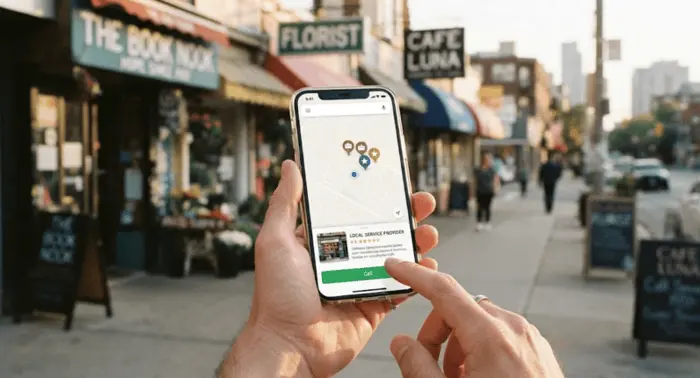
For most small businesses, local search is where the money is. When someone types “plumber near me” or “best bakery in town,” local SEO decides who shows up in the Google Map Pack.
An agency will:
- Set up and optimize your Google Business Profile
- Add photos, services, posts, and correct business hours
- Build local citations (consistent name, address, and phone across directories)
- Help you earn more Google reviews
3. Search Engine Optimization (SEO)
SEO helps your website rank higher in Google search results without paying for each click. It includes three parts:
- On-page SEO: keywords, titles, headings, and content
- Technical SEO: site speed, mobile-friendliness, Core Web Vitals, and indexing
- Off-page SEO: quality backlinks from trusted websites
SEO is slow but long-lasting. Once you rank, traffic keeps coming without extra ad spend.
4. AI Search Optimization (AEO and GEO)
This is the newest service, and many agencies still skip it. More people now ask questions in ChatGPT, Gemini, Perplexity, and Google AI Mode instead of scrolling through links.

- AEO (Answer Engine Optimization) structures your content so it gets picked as a direct answer in featured snippets and voice search.
- GEO (Generative Engine Optimization) helps AI tools mention and recommend your business in their answers.
An agency does this through clear Q&A content, schema markup, strong brand mentions across the web, and consistent business information.
5. Pay-Per-Click Advertising (Google Ads)
PPC puts your business at the top of Google instantly. You pay only when someone clicks your ad.
The agency handles keyword research, ad copy, bidding, negative keywords, and landing pages. Their job is to lower your cost per lead and stop wasted spend. Google Local Services Ads (the “Google Guaranteed” badge) are also a strong option for service businesses.
6. Social Media Marketing and Meta Ads
Social media builds trust and keeps your brand in front of people. An agency manages organic posting on Facebook, Instagram, TikTok, and LinkedIn, plus paid ads through Meta Ads Manager.
Paid social is great for reaching people before they search, using targeting by location, age, interests, and behavior. Retargeting ads also bring back visitors who left your site without buying.
7. Content Marketing and Video
Content answers your customers’ questions and builds authority. This includes blog posts, guides, short-form videos (Reels, TikTok, YouTube Shorts), infographics, and case studies.
Good content helps SEO, feeds your social media, and gets cited by AI search tools.
8. Email and SMS Marketing Automation
Email still gives one of the highest returns of any channel. An agency sets up:
- Welcome emails for new subscribers
- Abandoned cart reminders for online stores
- Monthly newsletters and promotions
- Review requests and appointment reminders by SMS
Once automation is built, it keeps working around the clock.
9. Website Design and Conversion Rate Optimization (CRO)
Your website is where all the traffic lands. If it’s slow or confusing, you lose customers.
An agency builds fast, mobile-friendly websites and landing pages. Then it uses CRO to test headlines, buttons, forms, and layouts so more visitors call, book, or buy.
10. Online Reputation Management
Around nine out of ten customers read reviews before choosing a local business. An agency helps you collect more positive reviews, respond professionally to negative ones, and monitor what people say about your brand online.
11. Branding and Creative Design
Strong branding makes small businesses look trustworthy. Agencies often create logos, color schemes, ad graphics, and brand guidelines so your business looks consistent everywhere.
12. Analytics, Tracking, and Reporting
This ties everything together. An agency sets up Google Analytics 4, Google Search Console, conversion tracking, and call tracking. You get a monthly report showing leads, sales, cost per lead, and return on ad spend.

What Working With an Agency Looks Like (First 90 Days)
Month 1: Audit and setup. The agency reviews your website, Google profile, ads, and competitors. It sets up tracking and builds the strategy.
Month 2: Launch. Ads go live, SEO fixes begin, content gets published, and social profiles get active.
Month 3: Optimize. The team reviews the data, cuts what isn’t working, and puts more budget into what is.
After 90 days, you should see clear early wins from ads and the first signs of SEO growth.
A Simple Example
Let’s say a family-owned plumbing company gets most of its jobs from word of mouth. Calls are slowing down.
An agency might:
- Optimize its Google Business Profile and ask happy customers for reviews
- Run Google Local Services Ads for “emergency plumber” searches
- Build service pages for each area the company covers
- Set up call tracking to see which channel brings in each job
Within a few months, the owner can see exactly which jobs came from Google Maps, which came from ads, and what each new customer costs. That’s the real value: clarity plus growth.
(This is an illustrative example, not a specific client result.)
Types of Digital Marketing Agencies
| Type | Best For |
|---|---|
| Full-service agency | Businesses that want everything handled in one place |
| Specialized agency (SEO, PPC, social) | Businesses that need one channel done really well |
| Local marketing agency | Service businesses targeting a city or region |
| Niche or industry agency | Businesses wanting a team that knows their industry (dental, legal, home services) |
| Freelancer or micro-agency | Tight budgets or one-off projects |
How Much Does a Digital Marketing Agency Cost?
Prices vary by country, scope, and agency size. Here are typical monthly ranges for small businesses in 2026 (USD):
| Service | Typical Cost |
|---|---|
| Local SEO | $500 – $2,000/month |
| Full SEO | $1,000 – $5,000/month |
| Google Ads management | $500 – $2,500/month or 10–20% of ad spend |
| Social media management | $500 – $3,000/month |
| Email marketing | $300 – $2,000/month |
| Website design | $500 – $5,000 one-time |
| Full-service package | $2,500 – $10,000/month |
Note: Ad spend (the money paid to Google or Meta) is usually separate from the agency’s management fee.
Common pricing models:
- Monthly retainer: fixed fee for ongoing work (most common)
- Project-based: one-time fee, like a website build
- Hourly: for consulting or small tasks
- Performance-based: fee tied to leads or sales
A useful rule: many small businesses spend around 7–8% of revenue on marketing overall. Use that to check if an agency quote fits your budget.
How Long Before You See Results?
| Channel | Typical Timeline |
|---|---|
| Google Ads / PPC | 1–4 weeks |
| Meta Ads | 2–6 weeks |
| Google Business Profile | 1–3 months |
| Social media growth | 3–6 months |
| Email marketing | Immediately after launch |
| SEO | 4–12 months |
| AI search visibility | 3–9 months |
Any agency promising page-one rankings in two weeks is a red flag.
KPIs That Actually Matter
Don’t judge an agency by likes and impressions. Ask for these numbers instead:
- Leads and calls generated
- Cost per lead (CPL)
- Customer acquisition cost (CAC)
- Conversion rate of your website
- Return on ad spend (ROAS)
- Organic traffic and keyword rankings
- Revenue influenced by marketing
Benefits of Hiring a Digital Marketing Agency
You save time. No more late nights learning Google Ads.
You get a full team. SEO experts, designers, writers, and ad managers for less than one full-time salary.
You get better tools. Agencies pay for premium tools like Semrush, Ahrefs, and call tracking software.
You get faster results. Experts avoid the costly trial and error most owners go through.
You can scale easily. Increase or reduce services as your business changes.
Agency vs. Freelancer vs. In-House vs. DIY
| Option | Cost | Skills | Best For |
|---|---|---|---|
| Agency | Medium | Wide team of experts | Growing businesses wanting full support |
| Freelancer | Low to medium | One skill | Single tasks or small budgets |
| In-house hire | High (salary + benefits) | Limited to one person | Larger businesses with steady needs |
| DIY | Low cost, high time | Your own learning | Very new businesses |
7 Questions to Ask Before Hiring an Agency
- Have you worked with businesses in my industry?
- Can you share real case studies or references?
- What KPIs will you report on, and how often?
- Will I own my website, ad accounts, and data?
- What is the contract length and cancellation policy?
- Who will actually work on my account?
- How do you handle AI search and Google algorithm updates?
Red Flags to Watch Out For
- Guaranteed #1 rankings on Google
- Reports full of vanity metrics but no leads or sales
- Ad accounts set up under the agency’s name, not yours
- Long lock-in contracts with heavy exit fees
- Cheap “SEO packages” built on spammy backlinks
- No clear strategy, just a generic package
Signs Your Business Is Ready for an Agency
- Marketing always gets pushed to “later”
- Sales have stopped growing
- You’re spending on ads but don’t know if they work
- Competitors show up on Google and you don’t
- You can commit to at least 6 months of consistent marketing
Frequently Asked Questions
Is it worth it to hire a marketing agency?
Yes, if you have clear goals and can commit for at least 6 months. An agency gives you a full team of experts for less than one in-house salary. It’s less worth it for very new businesses with almost no budget, where DIY tools or a freelancer may be a better start.
How much money can I make with a digital marketing agency?
It depends on your clients and services. Solo agency owners often earn $2,000 to $10,000 per month. Small agencies with a team and steady retainer clients can bring in $10,000 to $50,000+ per month in revenue. Profit margins usually range from 15% to 30%. Niche focus and recurring retainers drive the highest income.
Is digital marketing still worth it in 2026?
Yes. Customers still search, scroll, and shop online every day. What changed is how they search. AI tools, short-form video, and local search now matter more. Businesses that adapt to these shifts still see strong returns from digital marketing.
What is the cheapest way to promote your business?
The cheapest way is a fully optimized Google Business Profile. It’s free and puts you on Google Maps. Other low-cost options include collecting customer reviews, posting short videos on social media, email marketing to past customers, and asking for referrals.
Is AI replacing digital marketing?
No. AI is changing digital marketing, not replacing it. Tools like ChatGPT speed up writing, research, and ad testing. But strategy, creativity, brand voice, and understanding real customers still need humans. Marketers who use AI well are replacing those who don’t.
What type of marketing is most in demand?
The most in-demand areas are performance marketing (Google and Meta ads), SEO and AI search optimization, short-form video marketing, marketing automation, and data analytics. Businesses want marketing they can measure and tie directly to revenue.
What is the average fee for a digital marketing agency?
Most small businesses pay $1,000 to $5,000 per month. Hourly rates usually fall between $100 and $150 in the US. Full-service packages for larger needs can go above $10,000 per month. Ad spend is typically billed separately.
Is digital marketing a risky career?
Not more than most careers. Demand is steady because every business needs customers online. The risk is in staying still. Platforms and algorithms change often, so people who keep learning, especially AI tools and data skills, stay in demand.
What’s hot in marketing right now?
The biggest trends in 2026 are AI search optimization (GEO and AEO), short-form video, creator and UGC content, first-party data and email lists, hyper-local marketing, marketing automation, and personalized customer experiences.
Is it hard to find a marketing job in 2026?
Entry-level generalist roles are competitive. But people with specific skills like Google Ads, SEO, AI tools, analytics, or video editing find work faster. Building a portfolio, earning certifications (Google, Meta, HubSpot), and freelancing first can make job hunting much easier.
Final Thoughts
So, what does a digital marketing agency do for small businesses? It takes the guesswork out of growth. From local SEO and Google Ads to AI search, email, and reporting, a good agency gets you in front of the right people and proves its value with real numbers.
The key is choosing a partner who understands your business, reports on what matters, and adapts as search keeps changing.
Ready to grow your small business online? Book a free strategy call with our team, and we’ll show you exactly where your next customers are coming from.