
If you have to choose one first, invest in PPC when you need leads within the next 30 to 60 days, and invest in SEO first when you can wait three to six months in exchange for a channel that keeps generating traffic without paying for every click. Most growing businesses don’t actually have to pick just one forever, but almost everyone has to pick a starting point, and that starting point should be driven by your timeline, budget, and how competitive your industry already is, not by whichever channel your last agency happened to sell you.
Let’s walk through exactly how to make that call for your business.

What PPC and SEO Actually Do Differently
PPC, or pay per click advertising, places your business at the very top of the search results the moment your campaign goes live. You bid on keywords through platforms like Google Ads or Microsoft Advertising, and you pay each time someone clicks your ad. Turn the budget off, and your visibility disappears just as fast as it appeared.
SEO, or search engine optimization, works on your actual website. It involves improving technical health, publishing content that answers what your customers are searching, and earning backlinks that build authority in Google’s eyes. Nobody pays per click here. Instead, you’re investing time and effort into an asset that keeps ranking long after the work is done, though it can take several months before you see meaningful traffic.
The real difference isn’t just cost. It’s ownership. PPC rents attention. SEO builds an asset you keep.

The Four Questions That Actually Decide Your Answer
Every “it depends” article eventually boils down to the same four factors. Answer these honestly and the decision usually makes itself.
How soon do you need leads? If your sales pipeline is empty right now and you need customers this month, PPC wins simply because SEO cannot move that fast, no matter how good the strategy is.
How much can you commit monthly, and for how long? PPC can technically start with a few hundred dollars, but SEO rarely shows real traction before month four or five, and it needs consistent investment during that window even though nothing dramatic seems to be happening yet.
How competitive is your industry online? In crowded markets like insurance, legal services, or home services in major cities, ranking organically can take a year or longer. In that case, PPC often has to carry lead generation while SEO builds in the background.
How long is your typical sales cycle? Businesses with short, impulsive purchases (think local repair services) tend to see PPC convert quickly. Businesses with longer, research heavy buying journeys (think B2B software or professional services) tend to benefit more from SEO content that builds trust across multiple visits before someone ever fills out a form.

When PPC Should Come First
PPC usually deserves the first dollar when you’re launching a new product and have no existing search visibility, running a seasonal promotion with a hard deadline, testing which offers and messaging actually convert before committing to content, or simply need proof that digital marketing works before your business can justify a bigger budget.
There’s a data advantage here too. Every PPC campaign tells you exactly which keywords bring in clicks, which ones convert into leads, and what people actually type before they buy. That intelligence is incredibly useful later, because it removes the guesswork when you do start building out SEO content.
When SEO Should Come First
SEO deserves the first investment when your business already has some brand recognition or word of mouth reputation, you operate in a field where trust and credibility heavily influence buying decisions, such as healthcare, finance, or law, your sales cycle is long enough that you can afford to play the longer game, or you simply want to reduce how dependent your growth is on an advertising budget that could be cut at any time.
The payoff is real. Organic traffic doesn’t stop the moment you pause spending, and a well built page can keep bringing in leads for years with only occasional updates. Over time, this tends to lower your overall cost per lead in a way paid advertising alone cannot match.
A Practical Way to Split a Limited Budget
Very few growing businesses actually need to choose one channel exclusively. A common, sensible approach looks like this:
Start with a larger share of your budget, often somewhere around 60 to 70 percent, going toward PPC in the first few months. This buys you speed and real world data. Put the remaining 30 to 40 percent toward foundational SEO work: fixing technical issues, building out core service pages, and publishing content around the keywords your PPC data shows are actually converting.
As your organic rankings begin climbing and start generating consistent traffic, gradually shift the ratio. Reduce PPC spend on the specific keywords where you now rank well organically, and redirect that saved budget into new markets, new services, or keywords still out of organic reach.
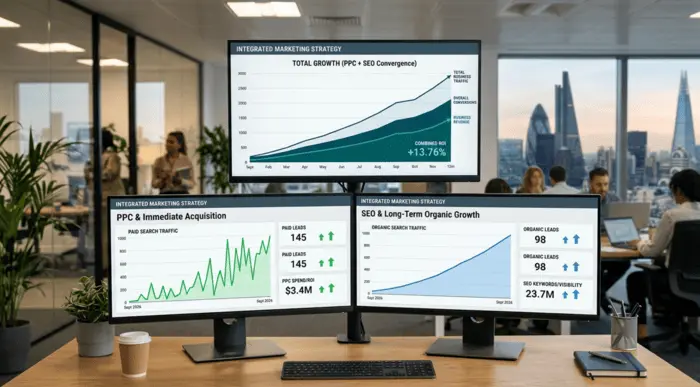
This sequencing lets PPC fund your visibility today while SEO quietly builds the asset that reduces your reliance on paid spend tomorrow.
Signs You’ve Waited Too Long to Start SEO
A common and expensive mistake is running PPC indefinitely without ever building an organic foundation. Watch for these warning signs: your cost per lead through PPC keeps climbing every quarter, your competitors are starting to outrank you organically while you’re still only visible through ads, or your business has been running for over a year with zero meaningful organic traffic. Any of these should prompt you to start SEO immediately, even if PPC remains your primary channel for now.
Frequently Asked Questions
Can a small business run PPC and SEO at the same time?
Yes, and for many growing businesses this is the ideal approach. PPC covers the gap while SEO builds, and the keyword data from PPC campaigns often makes SEO content planning faster and more accurate.
Is SEO cheaper than PPC in the long run?
Generally yes. PPC costs scale with clicks indefinitely, while SEO requires upfront and ongoing investment but does not charge per visitor once a page ranks, which typically lowers cost per lead over time.
How long does SEO take to show results compared to PPC?
PPC can generate traffic and leads within days of launching. SEO typically needs four to six months to show meaningful movement, and often six to twelve months for genuinely competitive keywords.
Should a brand new business start with PPC or SEO?
A brand new business with no existing traffic or authority often benefits from starting with PPC to generate early leads and gather keyword data, while beginning foundational SEO work in parallel so organic traction has already started building by the time PPC costs rise.
The Bottom Line
There’s no universal right answer to PPC versus SEO, only a right answer for where your business stands today. If you need revenue now, start with PPC. If you can invest patiently for a compounding return, start with SEO. And if your budget allows it, running both in a deliberate, phased sequence almost always outperforms betting everything on a single channel.
If you want a clear, data backed recommendation specific to your industry, budget, and growth stage, Xcel Digi can review your current position and build a phased PPC and SEO plan that matches where your business actually is right now.